Narrator: For the first time in history, average Americans have less education and are less prosperous than their parents.
出自電影《黑金風暴》 的經典對白。


更多黑金風暴的經典對白
Narrator: For the first time in history, average Americans have less education and are less prosperous than their parents.
Christine Lagarde: The financial industry is a service industry. It should serve others before it serves itself.
George Soros: Chuck Prince of Citibank famously said: 'That we have to dance until the music stops.' Actually, the music had stopped already when he said that.
Narrator: The financial industry also exerts its influence in a more subtle way, one that most Americans don't know about: It has corrupted the study of economics itself.
Narrator: Inequality of wealth in the United States is now higher than in any other developed country.

Henry Paulson: We're gonna keep growing. Okay? And, obviously, I'll say it: 'If you're growing, you're not in recession, right? I mean, we all know that.'
Nouriel Roubini: By 2006, about 40% of all profits of S&P 500 firms was coming from financial institutions.
George W. Bush: When I first came to office, I thought taxes were too high, and they were.

Narrator: The Bush administration sharply reduced taxes on investment gains, stock dividends and eliminated the estate tax.

David McCormick: Could we... could we turn this off for a second?
George W. Bush: You don't have to have a lousy home. The low-income home buyer can have just as nice a house as anybody else.

Narrator: For the first time in history, average Americans have less education and are less prosperous than their parents.

Christine Lagarde: The financial industry is a service industry. It should serve others before it serves itself.
Narrator: The financial industry also exerts its influence in a more subtle way, one that most Americans don't know about: It has corrupted the study of economics itself.
Narrator: Inequality of wealth in the United States is now higher than in any other developed country.

George Soros: Chuck Prince of Citibank famously said: 'That we have to dance until the music stops.' Actually, the music had stopped already when he said that.
Henry Paulson: We're gonna keep growing. Okay? And, obviously, I'll say it: 'If you're growing, you're not in recession, right? I mean, we all know that.'
Nouriel Roubini: By 2006, about 40% of all profits of S&P 500 firms was coming from financial institutions.

David McCormick: Could we... could we turn this off for a second?
George W. Bush: When I first came to office, I thought taxes were too high, and they were.

Narrator: The Bush administration sharply reduced taxes on investment gains, stock dividends and eliminated the estate tax.

George W. Bush: You don't have to have a lousy home. The low-income home buyer can have just as nice a house as anybody else.

interviewer: On your CV the title of this report has been changed from "Financial Stability in Iceland" to "Financial *In*stability in Iceland." Frederic Mishkin: Um, well, I don't know. Er, which, er whatever it is, is - the thing - if there's a typo, there's a typo.
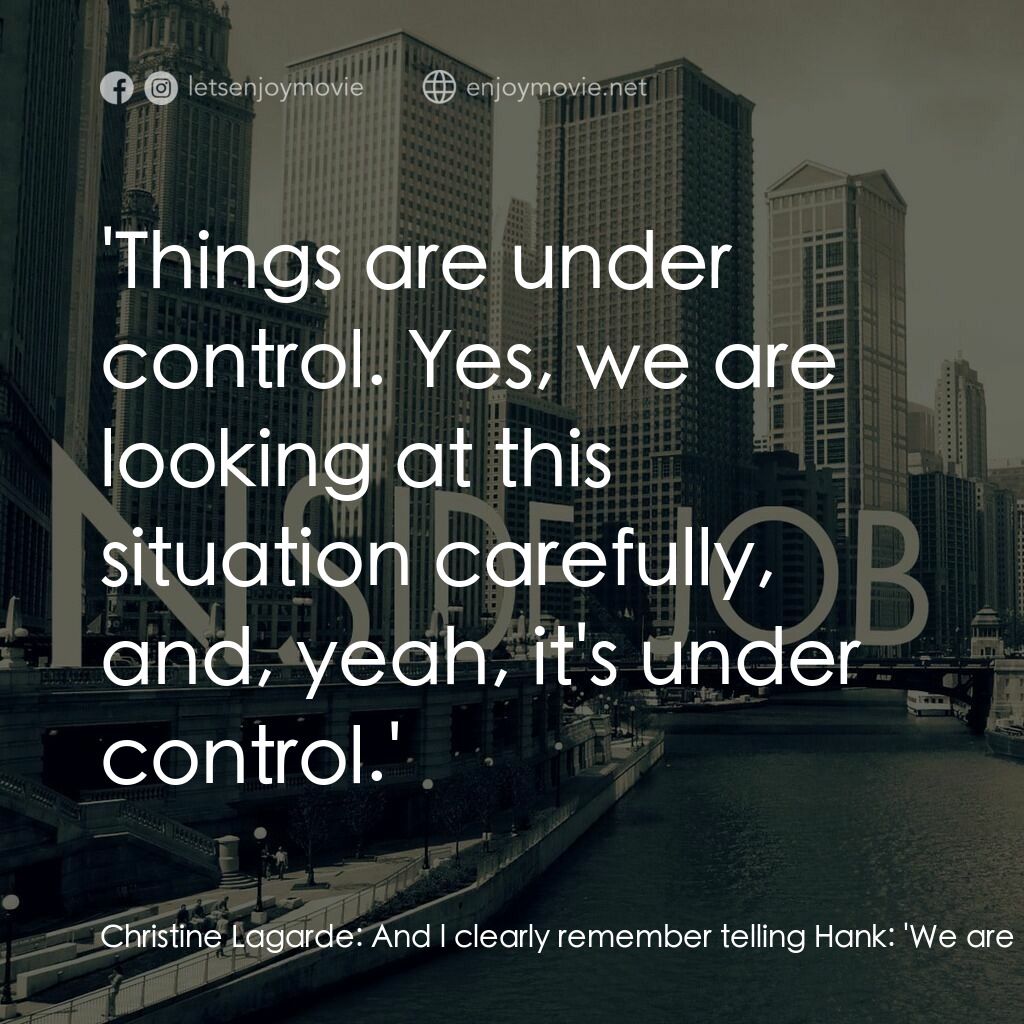
Christine Lagarde: And l clearly remember telling Hank: 'We are watching this tsunami coming, and you're just proposing that we ask: "which swimming costume we're going to put on."' interviewer: What was his response? What was his feeling? Christine Lagarde: 'Things are under control. Yes, we are looking at this situation carefully, and, yeah, it's under control.'
George W. Bush: We had a comprehensive plan that, when enacted, has left nearly $1.1 trillion in the hands of American workers, families, investors and small-business owners. Narrator: Most of the benefits of these tax cuts went to the wealthiest 1% of Americans.